The Core Distinction
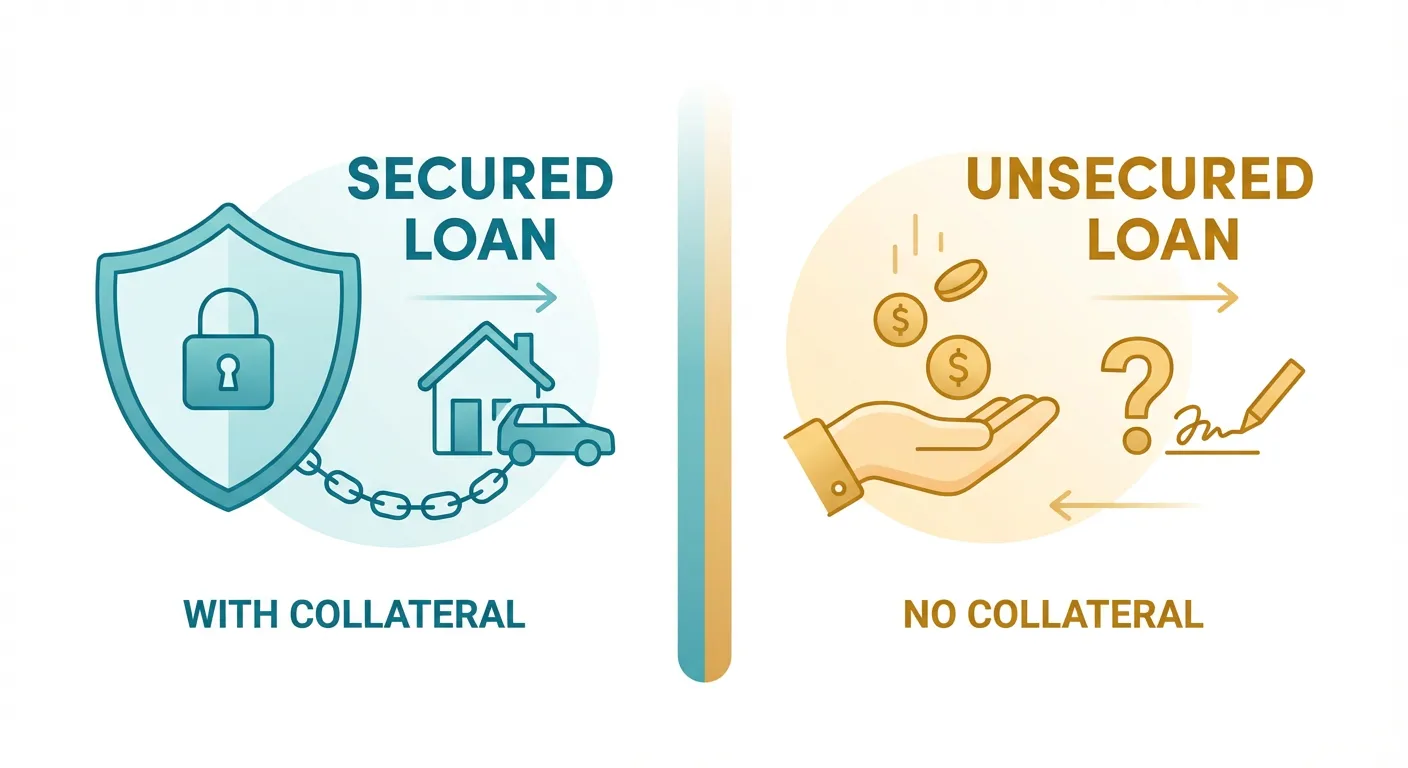
Every loan falls into one of two categories: secured or unsecured. The difference comes down to a single question — does the lender require you to pledge an asset as a guarantee?
Understanding this distinction is fundamental to making smart borrowing decisions, because it directly affects your interest rate, borrowing limits, approval likelihood, and the risk you take on.
In Simple Terms: A secured loan is backed by something you own. An unsecured loan is backed by your promise to repay.
How Secured Loans Work
With a secured loan, you pledge a specific asset — called collateral — that the lender can claim if you fail to repay. This significantly reduces the lender’s risk, which is why secured loans often come with more favorable terms.
Common types of secured loans:
-
Mortgages — Your home serves as collateral. If you default, the lender can foreclose on the property.
-
Auto loans — The vehicle you’re purchasing is the collateral. Failure to pay can result in repossession.
-
Secured personal loans — Backed by a savings account, certificate of deposit (CD), or other financial asset.
-
Home equity loans and HELOCs — Your home equity is the collateral, allowing you to borrow against the value you’ve built.
Why lenders offer better terms on secured loans: The collateral acts as insurance. If the borrower defaults, the lender can recover their loss by seizing and selling the asset. This reduced risk translates to lower interest rates, higher borrowing limits, and more flexible qualification requirements.
The Advantages of Secured Loans
Lower interest rates Because the lender has a safety net, secured loans typically carry significantly lower APRs than unsecured options. The difference can be substantial — sometimes 5 to 15 percentage points.
Higher borrowing limits Collateral gives lenders confidence to extend larger amounts. While unsecured personal loans typically cap around $50,000 to $100,000, secured loans (like mortgages) can reach into the hundreds of thousands or millions.
Easier approval for lower credit scores If your credit history isn’t strong, offering collateral can make the difference between approval and denial. Some secured loan products are specifically designed for borrowers who are rebuilding credit.
Longer repayment terms Secured loans often allow longer terms, which means lower monthly payments — though you’ll pay more interest over the life of the loan.
The Risks of Secured Loans
The biggest risk is straightforward: you can lose your asset. If financial hardship prevents you from making payments, the lender has the legal right to seize the collateral.
Other considerations:
- Asset depreciation — If the collateral loses value during the loan term (common with vehicles), you could owe more than the asset is worth.
- Longer commitment — Secured loans often come with longer terms, tying up your asset for years.
- More paperwork — Collateral requires appraisals, title searches, and additional documentation.
- Slower processing — The collateral evaluation process can extend approval and funding timelines.
How Unsecured Loans Work
An unsecured loan requires no collateral. The lender’s decision is based entirely on your creditworthiness — your credit score, income, employment history, and debt-to-income ratio.
Common types of unsecured loans:
-
Personal loans — The most common form of unsecured borrowing, used for everything from debt consolidation to major purchases.
-
Credit cards — A revolving form of unsecured credit with variable rates.
-
Student loans — Both federal and many private student loans are unsecured.
-
Medical financing — Payment plans offered through healthcare providers, often unsecured.
The Advantages of Unsecured Loans
No asset risk Your property, vehicle, and savings are not on the line. If you default, there are consequences — credit damage, collections, potential legal action — but the lender cannot seize specific assets through the loan agreement.
Faster application and funding Without the need for collateral appraisals, unsecured loans typically have a streamlined process. Many online lenders fund within one to three business days.
Simpler process Less paperwork, no title searches, no property inspections. The application is typically straightforward.
Flexibility Unsecured personal loans can generally be used for any purpose, unlike some secured loans that restrict how funds are used.
The Risks of Unsecured Loans
Higher interest rates Without collateral, the lender takes on more risk — and passes that cost to you. Unsecured loan rates are typically higher across the board.
Stricter credit requirements Lenders compensate for the lack of collateral by being more selective. Strong credit scores and stable income become even more important.
Lower borrowing limits Without an asset to back the loan, lenders typically cap unsecured loans at lower amounts.
Shorter terms available Unsecured loans generally offer shorter repayment periods, which means higher monthly payments.
Side-by-Side Comparison
Here’s how the two types stack up across the factors that matter most:
- Collateral required — Secured: Yes / Unsecured: No
- Typical APR range — Secured: 3% – 15% / Unsecured: 6% – 36%
- Approval difficulty — Secured: More accessible / Unsecured: Stricter requirements
- Borrowing limits — Secured: Higher / Unsecured: Lower
- Funding speed — Secured: Slower / Unsecured: Faster
- Risk to borrower — Secured: Asset loss / Unsecured: Credit damage, collections
- Best for — Secured: Large amounts, lower rates / Unsecured: Speed, flexibility, no collateral
How to Decide Which Is Right for You
Consider a secured loan if:
- You need to borrow a large amount
- You have a valuable asset you’re comfortable pledging
- You want the lowest possible interest rate
- Your credit score needs improvement and collateral could help you qualify
Consider an unsecured loan if:
- You don’t want to risk any assets
- You need funds quickly
- You have strong credit and can qualify for competitive rates
- The amount you need is moderate (under $50,000)
Pro Tip: Some borrowers use a combination — for example, a mortgage (secured) for their home purchase and a personal loan (unsecured) for the move-in costs. The right mix depends on your specific situation.
The Bottom Line
Neither secured nor unsecured loans are inherently better. The right choice depends on your financial situation, the amount you need, your credit profile, and your comfort level with risk. Understanding the tradeoffs puts you in a stronger position to negotiate and choose wisely.
This content is for educational purposes only. VictoryLoans.com is an independent educational resource — not a lender, bank, or financial advisor. Always consult with a qualified professional regarding your specific financial situation.