Why Your Repayment Strategy Matters
Making the minimum payment on a loan is like walking on a treadmill — you’re moving, but you’re not getting anywhere fast. The standard repayment schedule is designed to maximize the lender’s interest income, not to get you debt-free quickly.
The difference between a passive approach and an intentional strategy can be dramatic. On a $15,000 personal loan at 14% APR over five years, adding just $100 per month to your payment saves over $2,300 in interest and cuts your repayment time by nearly 18 months.
The Principle: Every extra dollar you put toward principal today eliminates interest charges on that dollar for the remaining life of the loan. Small, consistent efforts compound into significant savings.
Strategy 1: The Avalanche Method
The avalanche method is mathematically optimal. It saves you the most money in interest by targeting your highest-rate debt first.
How it works:
- Make minimum payments on all debts
- Put every extra dollar toward the debt with the highest interest rate
- When that debt is eliminated, redirect the full payment amount to the next-highest-rate debt
- Repeat until all debts are paid off
Example: You have three debts:
- Credit card: $4,000 at 24% APR
- Personal loan: $8,000 at 14% APR
- Car loan: $6,000 at 6% APR
You’d make minimums on the personal loan and car loan while aggressively paying down the credit card first. Once the card is paid off, you’d redirect that payment to the personal loan, and so on.
Best for: People who are motivated by math and long-term savings. The avalanche method requires patience because the highest-rate debt isn’t always the smallest balance.
Strategy 2: The Snowball Method
The snowball method prioritizes psychological momentum over mathematical optimization. It targets the smallest balances first, giving you quick wins that build motivation.
How it works:
- Make minimum payments on all debts
- Put every extra dollar toward the debt with the smallest balance
- When that debt is eliminated, redirect the full payment amount to the next-smallest balance
- Repeat until all debts are paid off
Why it works psychologically: Eliminating an entire debt — seeing a balance hit zero — creates a powerful sense of progress. That emotional reward keeps people engaged and committed to the plan.
The tradeoff: You may pay slightly more in total interest compared to the avalanche method because you’re not prioritizing the highest-rate debts first. However, research suggests that people using the snowball method are more likely to stick with their repayment plan and ultimately become debt-free.
Best for: People who need motivation and quick wins to stay on track. If you’ve tried and failed to pay off debt before, the snowball method’s psychological benefits may outweigh the mathematical cost.
Strategy 3: Biweekly Payments
This is one of the simplest and most effective strategies — and most people don’t know about it.
How it works: Instead of making one monthly payment, you make half the payment every two weeks.
Why it works: There are 52 weeks in a year, which means 26 biweekly payments — equivalent to 13 monthly payments instead of 12. You make one extra full payment per year without significantly impacting your monthly budget.
The impact on a $20,000 loan at 10% APR over 5 years:
- Standard monthly payments: $424.94/month, $5,497 total interest, paid off in 60 months
- Biweekly payments: $212.47 every two weeks, $4,689 total interest, paid off in approximately 54 months
Savings: $808 in interest and 6 months off the loan.
What to do: Check with your lender to confirm they accept biweekly payments and apply them correctly — each payment should reduce the principal immediately, not be held until the full monthly amount accumulates.
Strategy 4: Lump-Sum Payments
Whenever you receive unexpected or irregular income, directing it toward your loan can make a substantial impact.
Sources of lump-sum money:
- Tax refunds
- Work bonuses
- Freelance or side income
- Gifts or inheritances
- Selling items you no longer need
- Insurance refunds or rebates
The key mindset shift: Treat windfall money as if you never had it. Instead of absorbing it into your spending, redirect it straight to your loan. A single $1,500 tax refund applied to a $15,000 loan at 14% APR can save you over $700 in interest and shorten the loan by several months.
Pro Tip: Before making a lump-sum payment, verify that your lender applies extra payments to principal reduction — not to future payments. Some lenders will advance your due date instead of reducing your balance, which doesn’t save you interest.
Strategy 5: Round Up Your Payments
A micro-strategy that adds up significantly over time.
How it works: Round your payment up to the nearest $50 or $100. If your monthly payment is $347, pay $400 instead.
Why it works: The extra amount goes entirely toward principal, reducing the balance faster and cutting total interest. The additional $53 per month in this example would save hundreds in interest over the life of the loan and could shorten your term by several months.
This strategy pairs well with the other methods. You can round up while also following the avalanche or snowball approach for maximum impact.
Strategy 6: Refinancing to Better Terms
If your credit has improved since you took out your loan — or if market rates have dropped — refinancing into a lower-rate loan can reduce your total cost significantly.
When refinancing makes sense:
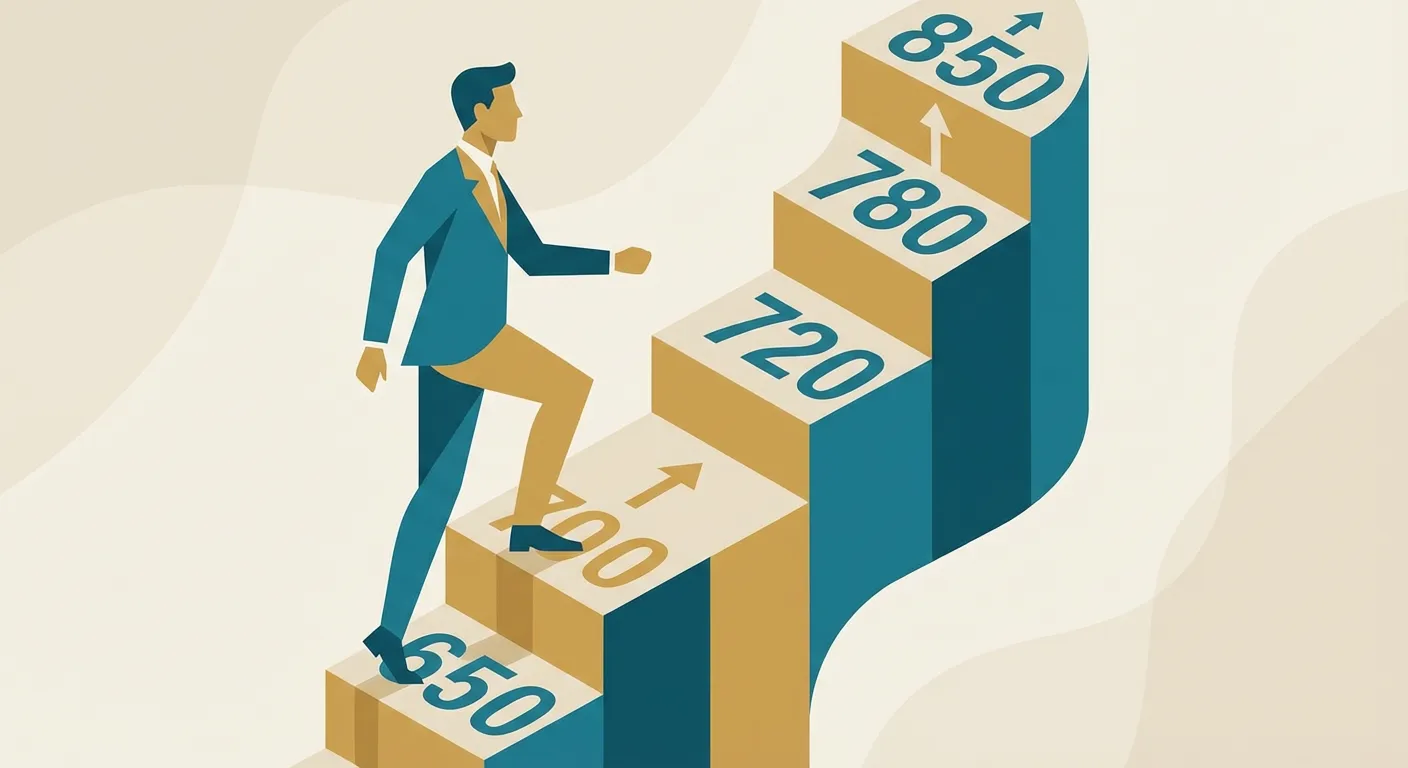
- Your credit score has improved by 50+ points since origination
- Market rates have dropped meaningfully
- You’re early enough in the loan term that the interest savings outweigh refinancing costs
- You can get a shorter term at a similar monthly payment
When it doesn’t make sense:
- You’re more than halfway through the loan (most of the interest has already been paid)
- The new loan carries significant origination fees
- You’d extend the term and pay more total interest despite the lower rate
What to do: Get prequalified with a few lenders (soft pull only) to see what rates you’d qualify for. Compare the total cost of your current loan vs. the total cost of the new loan, including all fees.
Building Your Repayment Plan
The best strategy is the one you’ll actually follow. Here’s how to build a plan that fits your life.
1. List every debt. Balance, interest rate, minimum payment, and remaining term.
2. Choose your primary method. Avalanche for maximum savings, snowball for maximum motivation. Either one works — the worst method is the one you abandon.
3. Find extra money. Review your monthly spending for subscriptions, services, or habits you can reduce. Even $50 to $100 per month in found money makes a real difference.
4. Automate everything. Set up autopay for your chosen payment amounts. Automation removes the temptation to skip or reduce payments.
5. Track your progress. Update a simple spreadsheet or use a debt payoff tracker monthly. Watching your balance drop reinforces the behavior.
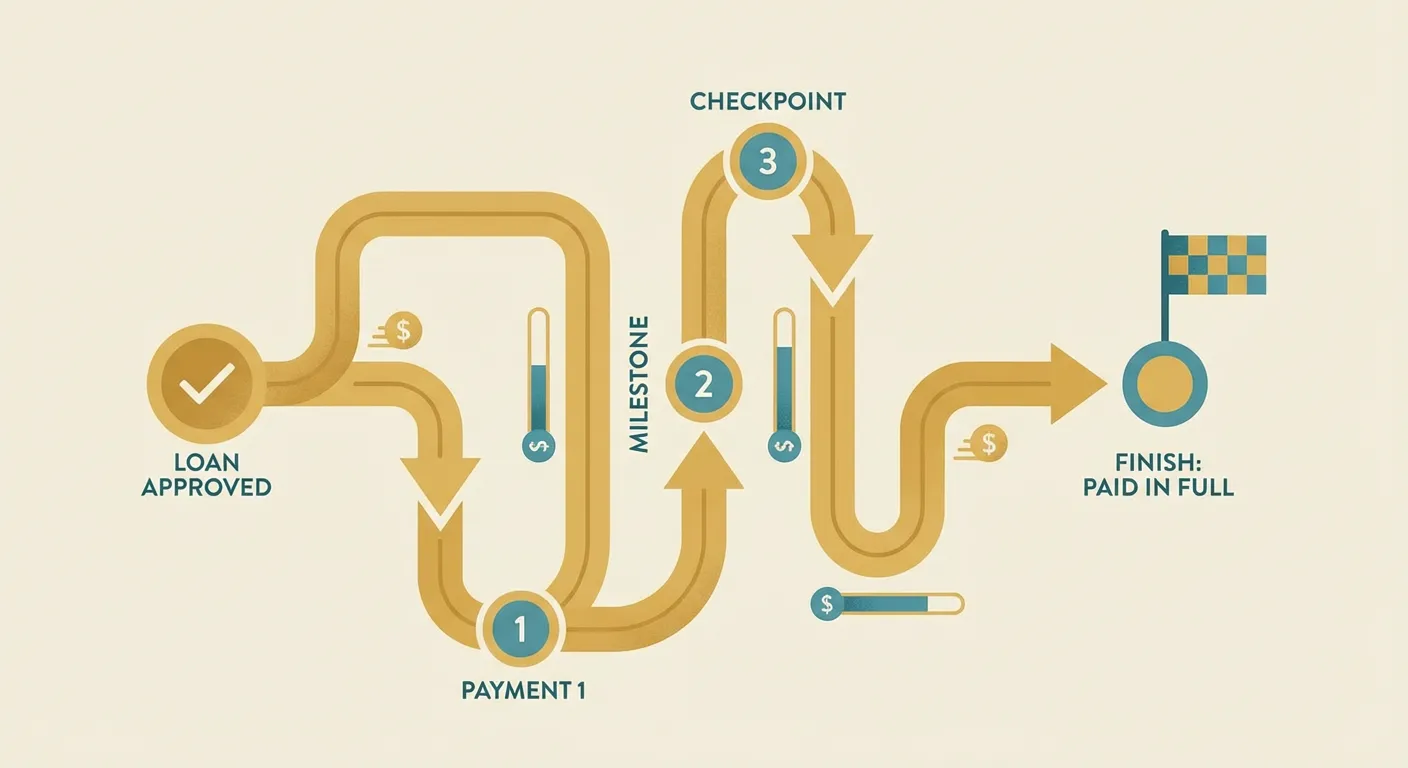
6. Celebrate milestones. When you pay off a debt or hit a balance milestone, acknowledge the achievement. A small, budget-friendly reward keeps you motivated for the long road.
Common Mistakes to Avoid
- Paying only minimums. Minimum payments are designed to keep the loan profitable for the lender, not to help you get debt-free.
- Ignoring the interest rate. A low monthly payment on a high-interest loan costs far more over time than a higher payment on a lower-interest loan.
- Depleting your emergency fund to make extra payments. Maintain at least a small cash buffer. Without it, one unexpected expense sends you right back to borrowing.
- Making extra payments without verifying they reduce principal. Always confirm with your lender how extra payments are applied.
- Waiting for the perfect strategy. Starting imperfectly today beats planning perfectly and starting never. Pick a method and begin.
The Compounding Effect of Good Habits
Loan repayment isn’t glamorous, but the financial freedom on the other side is worth the discipline. Every extra payment builds momentum. Every dollar of interest saved is a dollar that stays in your pocket. Every month ahead of schedule is a month closer to zero.
The strategies outlined here aren’t complicated. They don’t require financial expertise or unusual discipline. They require a decision, a plan, and consistency. Start with the strategy that feels most manageable, and build from there.
This content is for educational purposes only. VictoryLoans.com is an independent educational resource — not a lender, bank, or financial advisor. Always consult with a qualified professional regarding your specific financial situation.